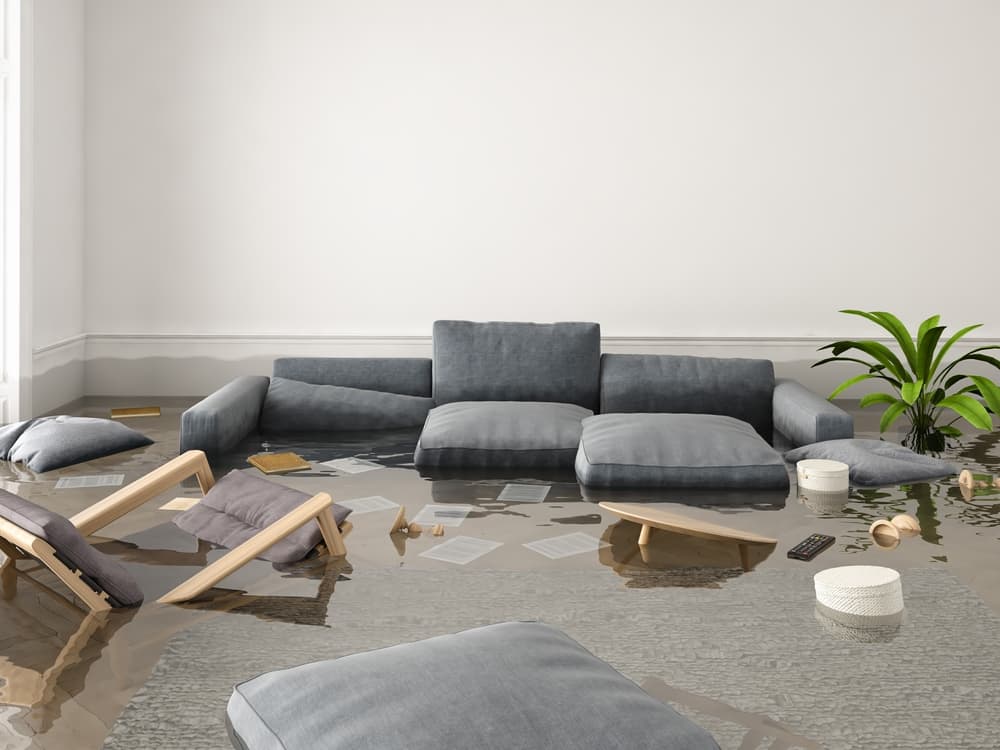
Here are the three categories of water damage so you can be prepared if it ever happens to your property.
Category 3 Water Damage
Northern Arizona University researchers indicate that Category 3 water damage is defined as “Grossly unsanitary water containing pathogenic agents, arising from sewage or other contaminated water sources and having the likelihood of causing discomfort or sickness if consumed or exposed to humans.” Category 3 water damage is considered grossly contaminated. It may also be called “black water.”
Category 3 water damage is more extreme. It includes:
- Sewage
- Other contaminated water sources that may have entered an indoor environment or affected it in some way
- Category 2 water that is not efficiently removed from an affected structure; it may be reclassified as Category 3
- Toilet backflows that began beyond the toilet trap, regardless of whether visible content is present or it has a particular color
- River or stream water
- Rainwater mixed with sewage
Category 2 Water Damage
Experts at Northern Arizona University also state that Category 2 water damage is defined as “Water containing a significant degree of chemical, biological and/or physical contamination and having the potential to cause discomfort or sickness if consumed by or exposed to humans.” When listed as Category 2 water damage, the water is considered significantly contaminated since it contains microorganisms and nutrients for microorganisms. It may also be called “grey water.”
Experts say Category 2 water damage events can include but are not limited to:
- Sprinkler water for fire protection
- Hydrostatic pressure seepage
- Sump pump collapses
- Toilet bowl overflow with urine (no feces)
- Washing machine discharge
- Dishwasher discharge
- Condensate and chilled water
Category 1 Water Damage
According to Northern Arizona University, Category 1 water damage is defined as “Water originating from a source that does not pose substantial harm to humans. Category 1 water is also referred to as ‘clean water.’” In other words, this water is considered sanitary.
Water damage events that may cause Category 1 water damage can include but are not limited to:
- Rainwater
- Melting snow
- Melting ice
- Broken appliance water lines
- Tub overflows
- Sink overflows
- Broken toilet tanks with no contaminants or additives
- Broken toilet bowls with no contaminants or additives
- Water Removal: Service work begins using extraction equipment and pumps.
- Damaged Material Removal: Non-restorable items are removed to expedite the drying process.
- Drying: Industry-leading drying equipment is used to remove the water you can’t see, after the bulk of the water has been remediated.
https://in.nau.edu/wp-content/uploads/sites/226/2020/03/Water-Damage-Guideline.pdf